


Table of Contents
- How We Evaluated Urgent Water Damage Mitigation Services
- Quick Comparison: Top Water Damage Mitigation Providers
- 1. Mr. Restore: 60-Minute Arrival and IICRC-Certified Technicians
- 2. ATI Restoration: Large-Scale Commercial Emergency Response
- 3. SOS Mitigation: Fast Arrival for Water Extraction and Drying
- 4. Lightspeed Restoration: Reliable Equipment for Residential and Commercial Properties
- How Long Does Water Mitigation Take?
- Water Damage Mitigation Best Practices
- Frequently Asked Questions
Last Updated: September 17, 2026
How We Evaluated Urgent Water Damage Mitigation Services
When a pipe bursts at 2 a.m., you need a crew on site before sunrise. Urgent water damage mitigation services stop the destruction while it is still reversible, and the difference between a two-day dry-out and a two-week rebuild usually comes down to how fast a certified team arrives.
We scored every provider on four criteria:
- Response time guarantees with written arrival windows
- Certifications and insurance billing capability
- Residential and commercial capacity
- Equipment depth for extraction, drying, and dehumidification
IICRC certification standards for restoration firms
Quick Comparison: Top Water Damage Mitigation Providers
| Provider | Response Guarantee | Certification | Best For |
|---|---|---|---|
| Mr. Restore | 60-minute arrival | IICRC-certified | Homes and businesses needing fast, insured mitigation |
| ATI Restoration | 24/7/365 dispatch | Industry-certified | Large commercial losses |
| SOS Mitigation | 90-minute arrival | Certified technicians | Fast water extraction and drying |
| Lightspeed Restoration | Rapid dispatch | Certified crews | Residential and commercial drying |
Response Time Guarantees
A written arrival window is the single most useful thing to compare. Verbal promises mean little at 3 a.m. Mr. Restore commits to a 60-minute arrival guarantee. Ask any provider to put the number in writing before you hang up.
Certifications and Insurance Billing
Certification tells you the technicians trained to a recognized standard, and direct insurance billing tells you the provider will deal with your adjuster instead of leaving you in the middle. Mr. Restore handles both: IICRC-certified technicians and direct billing that keeps the claim moving.
1. Mr. Restore: 60-Minute Arrival and IICRC-Certified Technicians
Mr. Restore combines a 60-minute arrival guarantee with 24/7/365 emergency response and direct insurance billing. The company has operated since 2008 and holds an IICRC certification, an A+ BBB rating, and 233 five-star reviews.
Ask for the Job-Dox update link at the start of the job. Watching moisture readings drop day by day tells you exactly when the structure is dry, rather than taking someone’s word for it.
2. ATI Restoration: Large-Scale Commercial Emergency Response
ATI Restoration runs 24/7/365 emergency dispatch and specializes in large-scale commercial cleanup. Property managers facing a multi-floor loss will find the capacity useful. Pricing is project-based and varies with damage severity, so get a written scope before work begins.

3. SOS Mitigation: Fast Arrival for Water Extraction and Drying
SOS Mitigation publishes a 90-minute response guarantee and focuses narrowly on extraction and drying. That focus pays off when you need standing water gone quickly. The tradeoff is coverage: the company serves specific regions only, so confirm your address falls inside the service area.
4. Lightspeed Restoration: Reliable Equipment for Residential and Commercial Properties
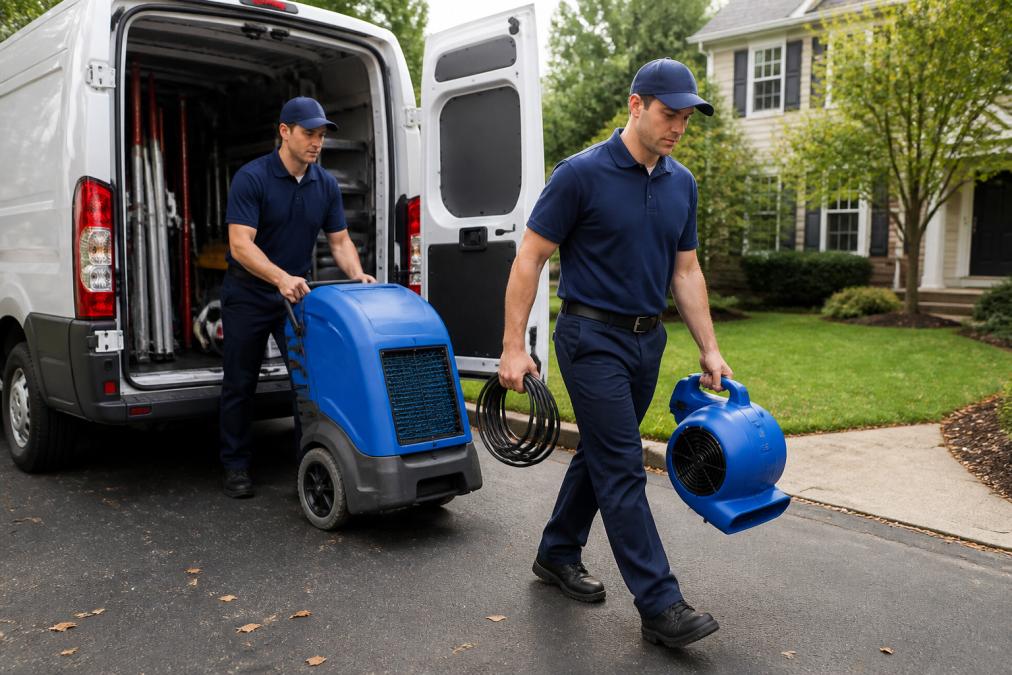
Lightspeed Restoration brings professional-grade extraction and drying equipment to both homes and businesses. Crews are equipped for immediate mitigation, and pricing depends on a site-specific damage assessment. It is a solid second call if your first choice is booked out.
How Long Does Water Mitigation Take?
Most water mitigation takes three to five days, though the exact timeline depends on the water category, the materials affected, and how quickly drying equipment is running. Extraction can finish in hours; structural drying takes longer because moisture trapped in drywall, subfloor, and framing releases slowly.
| Damage Level | Typical Timeline | What Happens |
|---|---|---|
| Category 1, small area | 3-4 days | Extraction, air movers, dehumidifiers |
| Category 2, multiple rooms | 4-5 days | Extraction, antimicrobial treatment, monitored drying |
| Category 3, contaminated water | 5+ days | Removal of affected materials, decontamination, drying |
What Actually Drives the Timeline
Four variables move the schedule more than anything else:
Water category. Category 1 (clean supply-line water) dries fastest. Category 2 (washing machine discharge, dishwasher leak) needs antimicrobial treatment and adds a day. Category 3 (sewage, floodwater) requires removing contaminated materials before drying even starts.
How Technicians Know When Drying Is Done
A technician uses a hygrometer and thermal imaging to track moisture inside walls and under flooring, then adjusts equipment until readings match a dry standard. The dry standard is established by taking moisture readings in an unaffected area of the same home, a closet, a hallway, and using those numbers as the target for the wet rooms.
Ask to see the daily moisture log. If readings are not trending toward the dry standard, the equipment setup needs to change, not the calendar.
What Can Extend a Job Past Five Days
- Water reached a concrete slab or crawlspace
- Cabinetry, built-ins, or tile were affected
- The loss involved Category 3 water and required material removal
- The home had no HVAC running, slowing ambient drying
- A second water source was discovered mid-job
- The structure was closed up without ventilation between visits
If a provider tells you the job will be done in two days without taking moisture readings first, that is a guess, not a schedule.
Water Damage Mitigation Best Practices
The best practice is to start mitigation within the first 24 to 48 hours, before water wicks into walls and secondary damage begins. But the more useful question is which losses you can safely handle yourself and which ones require a certified crew on site. That threshold is where most homeowners lose money, either by calling a pro for a spill a wet-dry vac could handle, or by treating a contaminated loss like a clean-water leak.
DIY vs. Professional: Where the Line Sits
If the affected area is smaller than roughly 10 square feet, the water is clean (Category 1), and you can reach the source within a few minutes, a shop vac, towels, and a household dehumidifier may be enough. Anything past that threshold tips toward professional mitigation.
- Water has been standing more than 24 hours
- The source is a sewage backup, toilet overflow with waste, or rising floodwater (Category 3)
- The source is a washing machine discharge, dishwasher leak, or aquarium water (Category 2)
- Water has reached drywall, subfloor, cabinetry, or insulation
- You can smell mustiness, or the area has been wet long enough for that to develop
- The loss involves more than one room or more than one level
- You cannot identify or stop the source
Do not run a household fan or shop vac over Category 3 water, which includes sewage backups and rising floodwater. It aerosolizes contaminants instead of removing them, and it puts anyone in the room at risk. The same applies to Category 2 water that has sat for more than 48 hours, it is treated as Category 3 at that point.
Documentation Best Practices for Your Insurance Claim
Documentation matters twice: it protects your health and safety, and it is the backbone of your insurance claim. FEMA guidance on documenting flood and water damage recommends photographing damage before cleanup and keeping receipts for every expense. For the claim itself, Consumer Financial Protection Bureau resources on filing insurance claims explains how to track your adjuster communications and what to do if a payout is delayed.
A documentation checklist that holds up under adjuster review:
- Photograph every affected room from multiple angles before anything is moved
- Photograph the source of the water (burst pipe, failed supply line, appliance)
- Video-walk the space narrating what you see and when you found it
- List every damaged item with brand, approximate age, and replacement value
- Keep every receipt, hotel, meals, rentals, replacement items
- Log every call: date, time, who you spoke with, what was agreed
- Ask the mitigation crew for moisture readings at the start and end of drying
- Request a written scope of work before signing anything
Habits That Make the First 48 Hours Count
- Shut off the water source and cut power to affected areas
- Photograph everything before anything is moved
- Call a certified provider and note your arrival time
- Keep a written log of every call, visit, and decision
- Ask for moisture readings at the start and end of drying
- Do not run HVAC in the affected zone, it spreads moisture through the house
Start a shared photo album on your phone the moment you notice the water. Time-stamped photos taken before cleanup carry more weight with adjusters than anything taken afterward.
Frequently Asked Questions
How long does water damage mitigation take?
Most residential water mitigation takes 3 to 5 days, depending on the water category, affected materials, and how quickly extraction begins. Category 1 clean water in a small area may dry in 2 to 3 days. Category 3 contaminated water or flooding that reaches subfloors and wall cavities can take 5 to 7 days or longer. Technicians use moisture mapping, hygrometers, and thermal imaging to confirm readings return to normal before removing equipment.
What should I do immediately after water damage?
Shut off the water source if you can reach it safely, then cut power to affected rooms at the breaker panel. Move furniture and valuables off wet carpet, and photograph everything before touching it. Do not use a household vacuum to remove standing water. Call a 24/7 emergency response line like Mr. Restore’s so extraction can start quickly. Fast action limits secondary damage and keeps your insurance claim straightforward.
Is water mitigation covered by insurance?
Most homeowners and commercial property policies cover sudden and accidental water damage, including burst pipes, appliance failures, and storm-driven water intrusion. Coverage typically includes extraction, structural drying, dehumidification, and sanitization. Gradual leaks or neglected maintenance are often excluded. Document the damage with photos, keep receipts, and ask your adjuster for the scope of covered work before authorizing anything beyond emergency mitigation.
How does professional water mitigation differ from standard cleanup?
Standard cleanup removes visible water and surface moisture. Professional mitigation goes further: technicians use moisture mapping, thermal imaging, and hygrometers to find hidden water inside wall cavities, subfloors, and ceilings. They deploy commercial-grade air movers, dehumidifiers, and air scrubbers to dry the structure to IICRC standards, then verify with daily readings. This prevents secondary damage and structural integrity issues that surface weeks later.
Why is a 24/7 emergency response critical for water damage?
Water spreads fast. Within 24 hours, drywall softens, wood swells, and metal fixtures begin to corrode. Within 48 hours, contaminated water can trigger microbial growth and musty odors. A 24/7 emergency response gets extraction equipment on site before that window closes. Mr. Restore offers a 60-minute arrival guarantee in its service areas, which stops water intrusion and limits the scope of repairs.
Water damage rarely waits for business hours, and the first hour decides how much of your property survives intact. Mr. Restore dispatches IICRC-certified technicians within a 60-minute arrival guarantee, bills your insurance directly, and keeps you updated through the Job-Dox system from extraction through final drying. Get started with Mr. Restore and stop the damage before it spreads.