


Table of Contents
- What Business Owners Should Know Before Choosing a Restoration Provider
- How to Compare ServiceMaster Alternatives: Key Evaluation Criteria
- Commercial Storm Damage Repair Contractors: What Sets the Best Apart
- Emergency Water Damage Restoration for Business: Response Time Matters
- The Restoration Company Insurance Claims Process Explained
- Why Mr. Restore Stands Out Among ServiceMaster Alternatives
- Frequently Asked Questions
Last Updated: September 10, 2026
What Business Owners Should Know Before Choosing a Restoration Provider
Choosing among the best servicemaster alternatives for business comes down to three things: how fast a crew arrives, whether the company bills your insurer directly, and whether its technicians hold current IICRC certification. This guide from Mr. Restore breaks down each factor so you can vet providers with confidence.
Here’s the uncomfortable truth most vendor lists skip: the brand name on the van matters far less than the franchise or crew that actually shows up. A national network can be excellent in one market and mediocre in the next, because local operators run the trucks, hire the technicians, and set their own dispatch priorities.
That’s why a service level agreement, not a logo, is the document that protects your business. Below, we’ll walk through the evaluation criteria that separate a genuine emergency partner from a call center with a referral list.
How to Compare ServiceMaster Alternatives: Key Evaluation Criteria
Compare restoration providers on four measurable criteria: emergency response time, technician certification, insurance billing capability, and reporting transparency. Everything else, from fleet size to marketing spend, is secondary to those four.
Response Time and Emergency Availability
Ask every provider for their guaranteed arrival window in writing, and ask what happens if they miss it. A 24/7 dispatch line means nothing if the crew on call is three counties away at 2 a.m.
Water damage mitigation is a clock-driven service. Extraction equipment, industrial air movers, and dehumidifiers have to be on site before saturation spreads into wall cavities and subfloors. Providers that publish a hard arrival commitment, rather than a vague “prompt response,” give you something enforceable.
Certifications, Compliance, and Insurance Integration
IICRC certification is the Institute of Inspection, Cleaning and Restoration Certification’s credential for water, fire, and textile restoration technicians. It signals that a technician has completed standardized training in drying science, documentation, and safety rather than learning on the job.
Verify it directly. The IICRC certified firm and technician locator lets you confirm a company’s registration before you sign anything. Pair that with a check on your state’s licensing board and the company’s standing with the Better Business Bureau, which tracks complaint patterns over time.
Compliance standards also cover the paperwork side: hazard mitigation protocols, jobsite safety documentation, and photo evidence that satisfies adjusters. A provider that treats documentation as an afterthought will slow your claim.
| Evaluation Criterion | What to Ask | Red Flag |
|---|---|---|
| Emergency response time | Guaranteed arrival window in writing | No stated commitment |
| Technician certification | Current IICRC credentials, verifiable | “We’re certified” with no proof |
| Insurance integration | Direct billing available? | You pay upfront, chase reimbursement |
| Reporting transparency | Real-time job updates? | No updates until invoicing |
| Coverage area | Local crews or subcontracted? | Out-of-area dispatch |
| Contract terms | Itemized scope before work | Blanket authorization to bill |
Commercial Storm Damage Repair Contractors: What Sets the Best Apart
Commercial storm damage repair contractors separate themselves through pre-loss planning, not post-storm promises. The best ones have already walked your building, documented its systems, and know where the shutoffs are before a storm hits.
That distinction matters most for multi-location operators, and it is the angle most vendor lists skip entirely. A restaurant group, a retail chain, or a property management portfolio needs a provider that can dispatch to several sites at once, assign a single project manager to the account, and keep reporting consistent across locations. A local franchise with one crew and one dispatcher can be excellent for a single building and still fail a national account, because scalability is a procurement question, not a marketing one.
What a National Account Actually Requires
When you evaluate a provider for more than one site, ask these questions in writing:
- Single point of contact. Is there one account manager who owns every location, or does each site get routed to a different local office?
- Simultaneous dispatch. If three sites flood in the same storm, can the provider staff all three at once, or do you go into a queue?
- Uniform documentation. Do all locations receive the same reporting format, photo standards, and moisture-log cadence, or does each office improvise?
- Consolidated invoicing. Can the provider bill your insurer or your AP department once per event across sites, or will you reconcile separate invoices from separate operators?
- Priority status. Does your account carry a contractual priority tier, or are you competing with every other caller during a regional event?
A franchise network’s coverage map is not the same thing as national account capability. Coverage tells you where vans can go. Account structure tells you whether those vans will show up for you first.
Build Restoration Into Your Preventative Maintenance Calendar
What most guides miss is that facility management teams should build a restoration vendor into their preventative maintenance calendar, not their emergency contact list. Annual walkthroughs, updated floor plans, shutoff locations, riser diagrams, and a documented priority list turn a chaotic first 48 hours into an executed plan.
The deliverable you want from that planning work is a pre-loss agreement: a signed document that sets response commitments, rates, and dispatch priority before you have a loss. Providers who will not put terms in writing ahead of an event are telling you something about how the event itself will go.
Ask a prospective provider to run a tabletop exercise on your building before you ever need them. Give them a hypothetical burst pipe on a Saturday night and have them walk you through dispatch, documentation, and insurer notification step by step. Then ask them to run the same exercise for three of your locations at once. The quality of that second answer tells you more about their national account readiness than any brochure.
Emergency Water Damage Restoration for Business: Response Time Matters
Emergency water damage restoration for business is a race against absorption. Every hour water sits in a commercial space increases the odds of structural saturation, warped flooring, and lost revenue from closure. But ‘response time matters’ is where most guides stop, and it is where your due diligence should start.
Benchmarking the SLA: What to Demand in Writing
A service level agreement is the document that turns a marketing promise into an enforceable commitment. Most business owners sign one without knowing what a strong one contains. Use this as your benchmark:
| SLA Element | Weak Language | Strong Language |
|---|---|---|
| Arrival window | “Prompt response” | A stated number of hours from first contact, with a clock that starts when you call |
| After-hours coverage | “Available 24/7” | Named on-call contact, same arrival commitment on nights, weekends, and holidays |
| Missed-window remedy | None stated | A defined remedy or escalation path if the window is missed |
| Drying milestones | “We’ll monitor” | Scheduled moisture readings with target dry-standard dates you can track |
| Documentation cadence | “Updates as needed” | Daily photo logs and moisture maps delivered through a client portal |
| Scope changes | Verbal approval | Written change orders required before additional work proceeds |
| Subcontracting | Not addressed | Disclosure of whether crews are employees or subcontracted, and who supervises |
| Termination | Not addressed | Your right to reassign the job if milestones are missed |
Two elements on that table do the most work. First, the arrival clock: a commitment measured from your first contact, not from when a dispatcher gets around to logging the job. Second, the drying milestones: a provider that commits to target dry-standard dates is putting its own process on the record, which is the opposite of the vague ‘we’ll monitor it’ language that leaves you with no leverage. restoration management software.
Why the Arrival Clock Is the Whole Ballgame
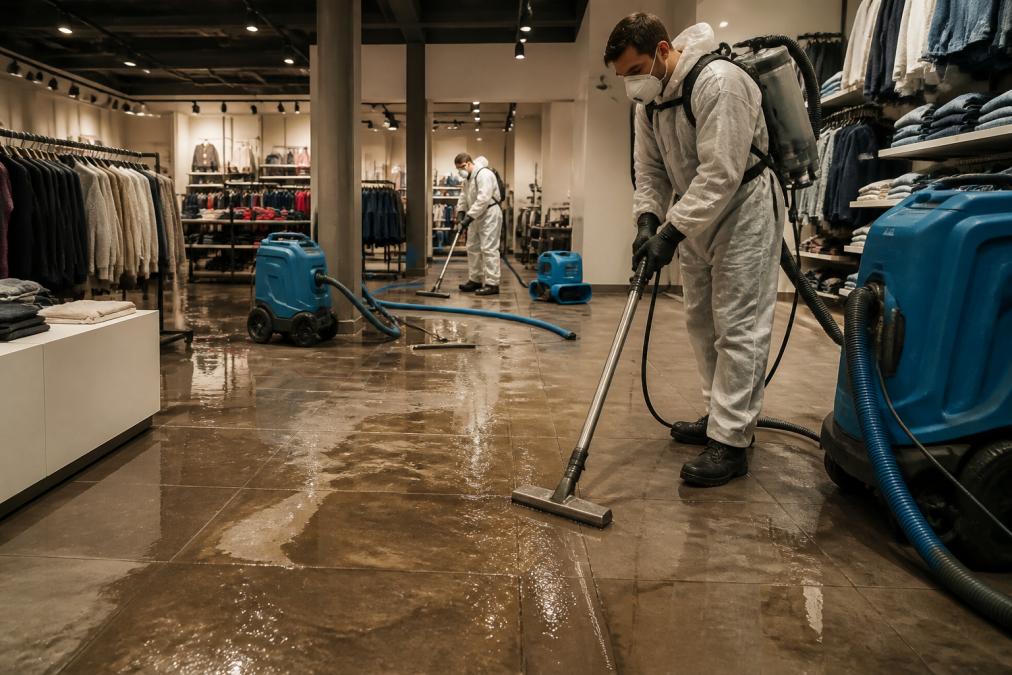
Water migration is not linear. In a commercial space, water wicks into wall cavities, travels along joists, and pools under flooring before it ever shows on a visible surface. Extraction equipment, industrial air movers, and dehumidifiers have to be on site before saturation spreads into assemblies that are far more expensive to dry than to extract.
Turnaround time drives the real cost. A retail store or restaurant that reopens in three days absorbs a fraction of the loss of one shuttered for three weeks. That is why the arrival guarantee and the drying timeline should both appear in your service level agreement, with milestones you can track and a remedy if they slip.
Real-Time Tracking Changes the Dynamic
When a provider shares drying logs, moisture readings, and photo documentation through a client portal, you can update your insurer, your landlord, and your staff without chasing anyone by phone. That same documentation is what your adjuster needs to approve the claim, so a provider that treats reporting as a core deliverable is also a provider that shortens your claim cycle.
The single most useful question you can ask a restoration provider is not ‘how fast can you get here.’ It is ‘what happens if you don’t.’ A provider with a written answer to that question has a process. A provider without one has a slogan.
The Restoration Company Insurance Claims Process Explained
The restoration company insurance claims process typically follows five stages: emergency mitigation, damage documentation, scope of work, adjuster review, and final invoicing. Knowing the sequence lets you spot delays early.
Direct Billing vs. Reimbursement: What to Expect
Direct billing means the restoration company invoices your insurer and collects payment from them, leaving you responsible only for your deductible and any uncovered items. Reimbursement means you pay the full invoice upfront and wait for the carrier to reimburse you.
For a business owner, the difference is cash flow. A five-figure mitigation invoice sitting on your books for sixty days is a real problem, especially when you’re already absorbing lost revenue. Ask any provider to put their billing model in writing before work begins, and confirm it with your adjuster.
Insurance claim processing also depends on documentation quality. Adjusters approve what they can verify, so photo evidence, moisture maps, and itemized scopes move claims faster than narrative summaries. The Federal Emergency Management Agency guidance on documenting disaster damage offers a useful reference for the kind of records that support a claim.
Never sign a broad authorization to bill before you have an itemized scope of work. Without it, you have no way to compare the final invoice against what was actually approved, and disputes become your problem to untangle.
Why Mr. Restore Stands Out Among ServiceMaster Alternatives
Mr. Restore is a family-owned, IICRC-certified restoration company built around a 60-minute arrival guarantee and 24/7/365 emergency response.
The differentiators are operational, not promotional. Direct insurance billing removes the reimbursement wait. The Job-Dox system gives you real-time project updates instead of silence. IICRC-certified technicians handle both commercial and residential losses, from sewage backups to smoke damage.
Eighteen years in business and 233 five-star reviews reflect a neighbors-first approach rather than a franchise script. For a property manager juggling an apartment complex or an owner trying to reopen a restaurant, that combination of speed, documentation, and direct billing is what actually shortens the recovery timeline.
Frequently Asked Questions
What should businesses look for in a commercial restoration provider?
Focus on four things: emergency response time (a 60-minute arrival guarantee is a strong benchmark), IICRC certification for technicians, direct insurance billing capability, and experience with commercial properties like restaurants and retail spaces. Also check whether the provider offers real-time project tracking and can coordinate with property managers or HOA boards. These factors directly affect how quickly your business reopens after water, fire, or storm damage.
How does the restoration company insurance claims process work?
A qualified restoration provider documents all damage with photos and moisture readings, prepares a detailed scope of work, and submits it directly to your insurance adjuster. The best providers offer direct billing, meaning they communicate with your insurer throughout the process so you are not stuck coordinating between multiple parties. This typically shortens the claims timeline and reduces out-of-pocket uncertainty for business owners.
How do I compare commercial restoration companies for emergency response?
Ask each provider about their guaranteed arrival window, whether they operate 24/7/365, and how they dispatch crews after hours. Request examples of past commercial projects similar to your property type. Verify IICRC certification and check review platforms for patterns in customer feedback about response times. A written service level agreement that specifies arrival windows and communication protocols gives you enforceable expectations rather than verbal promises.
What are the benefits of choosing a family-owned restoration company over a national franchise?
Family-owned restoration companies often provide more direct accountability because the owners live in the communities they serve. You typically work with the same project manager from assessment through completion rather than being routed through a call center. Local ownership also means faster decision-making on complex jobs and a reputation tied to the specific market, which encourages higher service quality. Mr. Restore, for example, has served its region since 2008 with a 60-minute arrival guarantee.
When a pipe bursts or a storm tears through your building, the provider you call determines how long your doors stay closed. Mr. Restore combines a 60-minute arrival guarantee, 24/7/365 emergency response, direct insurance billing, and real-time Job-Dox project updates so you’re never guessing about progress. Get started with Mr. Restore and get your business back to operating.