


Table of Contents
- Why Every Business Needs a Commercial Water Damage Restoration Checklist
- Immediate Safety Precautions and Emergency Water Damage Repair for Businesses
- Water Extraction, Structural Drying, and Water Damage Mitigation Best Practices
- Building a Commercial Property Emergency Response Plan
- The Commercial Water Damage Insurance Claims Process, Step by Step
- Business Continuity, IoT Monitoring, and Commercial Compliance
- Conclusion
- Frequently Asked Questions
Last Updated: September 16, 2026
Why Every Business Needs a Commercial Water Damage Restoration Checklist
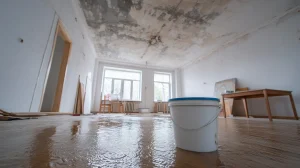
A pipe bursts above your sales floor at 2 a.m. By the time your opening manager arrives, water has spread across 4,000 square feet of carpet and is wicking up drywall. The next 60 minutes decide whether you reopen in three days or three weeks.
The most expensive mistake is waiting until morning to call. Water migrates through subfloor saturation and into wall cavities overnight, and the drying scope can double before anyone arrives.
Immediate Safety Precautions and Emergency Water Damage Repair for Businesses
Emergency water damage repair for businesses starts with three actions in order: shut off the water source, cut power to the affected zone, and document conditions before anything is moved. Do not enter standing water near electrical panels.
Shutting Off Utilities and Isolating the Affected Zone
Locate the main shutoff and the breaker panel before you need them. During an event, shut the supply valve first, then de-energize every circuit serving the wet area. Isolate the zone with barriers so staff and customers stay out, and shut down the air handler if it draws from the flooded space.
- Shut off the main water supply
- De-energize affected circuits at the breaker
- Close off the zone with physical barriers
- Photograph conditions before moving anything
Water Categories, Classes, and What They Mean for Your Building
Water losses are classified two ways, and both drive the scope of work. Category describes how contaminated the water is; class describes how much moisture materials absorbed and how hard they will be to dry. The ratings are independent, a loss can be Category 1 and Class 4, or Category 3 and Class 1, and the combination determines what gets dried in place and what gets removed.
| Category | Source Example | Handling Approach |
|---|---|---|
| Category 1 | Supply line break, sprinkler discharge | Dry in place, standard extraction |
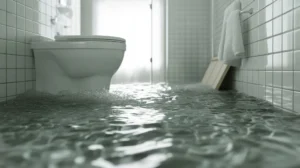
| Category 2 | Appliance discharge, toilet overflow (no solids) | Antimicrobial application, monitor |
| Category 3 | Sewage backup, ground surface water | Remove porous materials, HEPA filtration |
Class is about drying difficulty, not contamination:
- Class 1, minimal absorption. Carpet and a small area of subfloor. Air movers and dehumidification handle it quickly.
- Class 2, water has wicked up walls and saturated carpet and cushion across a large area. Requires airflow into wall cavities.
- Class 3, water came from above and saturated ceilings, walls, insulation, and subfloor. Typically the fastest to spread and the slowest to dry.
- Class 4, deep or bound water in materials that do not release moisture easily: hardwood, concrete, plaster, and stone. Needs specialty drying with low-humidity air and longer run times.
Category 3 water in a commercial space is not a dry-in-place situation. Porous materials that absorbed it, carpet, cushion, drywall, ceiling tile, insulation, are typically removed and disposed of, not dried. Trying to save them is the most common reason a commercial loss turns into a repeat problem.
Ask for the category and class in writing on day one. Those two ratings are the basis for the drying plan, the equipment count, and the documentation your adjuster will review.
Water Extraction, Structural Drying, and Water Damage Mitigation Best Practices
Water damage mitigation best practices follow a fixed sequence: extract standing water, map moisture, then dry with controlled airflow and dehumidification. Skipping the mapping step is why so many commercial losses return as repeat moisture problems.
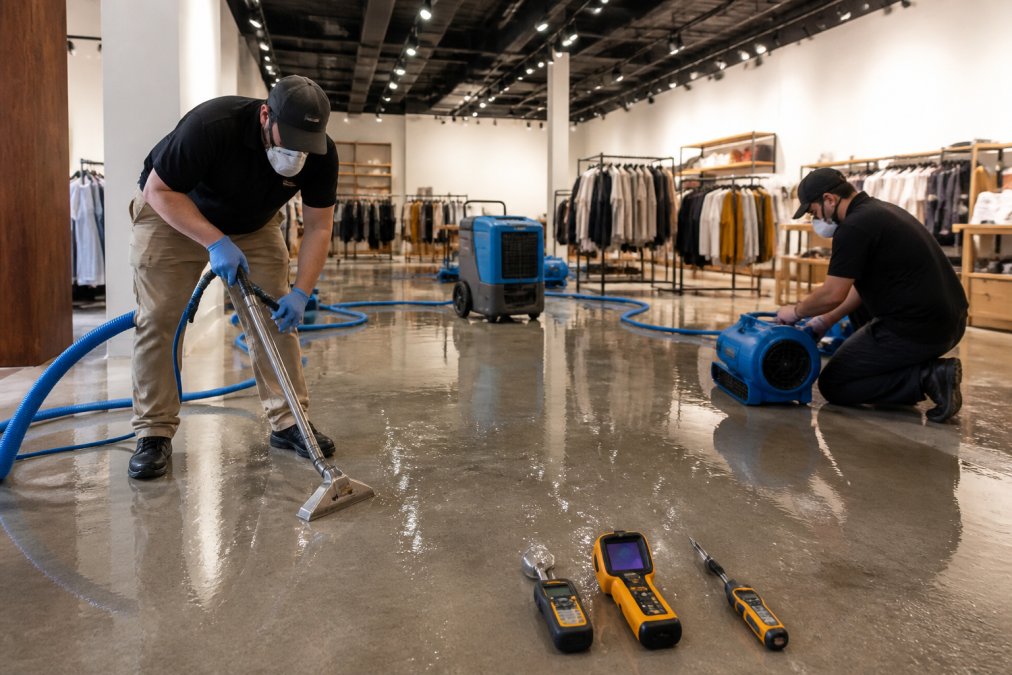
Moisture Mapping, Thermal Imaging, and Drying Equipment
Moisture mapping uses thermal imaging and a hygrometer to find water you cannot see. Technicians check wall cavities, ceiling voids, and subfloor saturation, then set drying goals from psychrometry readings.
Sanitization, HVAC Decontamination, and Content Cleaning
Antimicrobial application follows extraction, not before it. HVAC decontamination matters when the air handler pulled moisture through ductwork: coils, plenum, and registers all need inspection and cleaning. Content cleaning covers inventory, fixtures, and electronics, and it should start early so salvageable items are not lost to sitting water.
Ask for daily moisture readings in writing. Drying is finished when materials return to their dry standard, not when the floor looks dry to the eye.
Building a Commercial Property Emergency Response Plan
A commercial property emergency response plan names who calls whom, where shutoffs are, and which spaces get priority. It should fit on two pages and live somewhere staff can find it without power.
Build it with these components:
- Named after-hours contact and escalation chain
- Shutoff and breaker locations, mapped
- Zone priority list: what must come back online first
- Vendor contacts, including your restoration provider
- Insurance policy number and adjuster contact
- Annual walkthrough to confirm nothing has moved
The Commercial Water Damage Insurance Claims Process, Step by Step
The commercial water damage insurance claims process moves faster when loss documentation is complete on day one. Adjusters approve what they can verify, so make verification easy.
- Report the loss to your carrier and get a claim number
- Photograph and video every affected area before cleanup
- Keep a written timeline of when water was discovered and stopped
- Save damaged inventory and materials for adjuster review
- Get a scope of work with moisture readings attached
- Track every business interruption cost separately
- Review the settlement against the documented scope
Direct insurance billing removes the gap between what you owe and what the carrier reimburses. Mr. Restore documents the loss and bills your carrier directly, so you are not fronting the mitigation cost while the claim is reviewed.
::: Maintaining meticulous insurance claim documentation ensures that every structural vulnerability is accounted for during the settlement process.
Business Continuity, IoT Monitoring, and Commercial Compliance
Most guides stop at drying. For a commercial property, the harder question is how fast you can legally and safely reopen. Three areas separate a two-day closure from a two-month one: a written continuity plan, early detection, and the compliance conditions your occupancy type imposes.
Business Continuity Planning: The Reopening Checklist
Business continuity planning is what separates a two-day closure from a two-month one. Decide now which operations can run from a second location, which inventory can be relocated, and how you will communicate with customers during the outage. Build the plan around these steps:
- Identify a secondary operating location or a work-from-elsewhere arrangement for each critical function
- List the equipment, inventory, and records that must be relocated first if the primary site is unusable
- Set a communication tree for staff, customers, vendors, and your landlord or property manager
- Pre-authorize a restoration provider so mitigation can start without waiting on a signature
- Document your point-of-sale, phone, and network dependencies so you know what has to come back online first
- Define the trigger for declaring a business interruption and who has authority to make that call
- Schedule an annual tabletop walkthrough so the plan is tested, not just filed
IoT and Smart Monitoring for Commercial Properties
IoT and smart monitoring have changed the detection side. Leak sensors on supply lines, risers, and mechanical rooms alert a manager within minutes rather than at opening time. For multi-tenant properties, that early warning is the difference between one unit and a whole floor.
What to monitor, and why each point matters:
- Supply lines and risers, the most common failure point, and the hardest to see behind walls
- Mechanical rooms and boiler areas, slow drips that go unnoticed until the floor is saturated
- Below-grade spaces and elevator pits, fill first, drain last, and often hold the most expensive equipment
- Roof drains and scuppers, the first place a storm loss announces itself
- Restrooms and break rooms, high-traffic, high-failure areas with supply and drain lines in the same wall
Commercial-Specific Compliance and Reopening Conditions
Commercial-specific compliance adds another layer. Health departments, fire marshals, and building codes impose reopening conditions that vary by occupancy type. A restaurant cannot reopen on a dried floor alone; it needs health inspection clearance. A medical office may need to show patient-care areas were cleaned to a defined standard. A warehouse with racking may need a structural check before inventory goes back up.
- Moisture readings by date and location, showing the dry standard was reached
- Equipment logs showing what ran, where, and for how long
- Photographs before, during, and after mitigation
- The scope of work and any change orders
- Clearance documentation from the restoration provider
Supply Chain and Resource Allocation During Regional Events
Supply chain and resource allocation matter when a regional storm hits. Extraction units, dehumidifiers, and air movers get committed to the largest losses first. A provider with local inventory and a 60-minute arrival guarantee, like Mr. Restore, gets equipment on site before the regional shortage starts. If you are outside that window, expect to wait, and plan your continuity timeline around equipment not being available on demand.
Business continuity, early detection, and compliance sign-off are the three levers that decide how long a commercial property stays closed. A checklist that covers drying but not reopening is only half a plan.
Conclusion
Every commercial water loss is a race between drying and secondary damage. The businesses that recover fastest have a checklist already written, a response plan already tested, and a restoration partner already on call.
Frequently Asked Questions
What are the essential steps in a commercial water damage restoration process?
The process follows a set sequence: secure the site and shut off utilities, classify the water and inspect the affected materials, extract standing water, dry the structure with air movers and dehumidifiers, sanitize surfaces and HVAC components, and document everything for the insurance claim. Each step follows the IICRC S500 standard, and skipping ahead, such as drying before extraction is complete, slows the whole project and raises the risk of secondary damage.
What is the difference between category 2 and category 3 water damage?
Category 2 water, or greywater, carries some contamination, such as discharge from a washing machine or a toilet bowl without solid waste. Category 3 water, or blackwater, is grossly contaminated and includes sewage backups, ground surface water, and rising floodwater. Category 3 requires more aggressive extraction, disposal of porous materials, and antimicrobial application. The category determines how your commercial water damage restoration checklist is executed and how your claim is documented.
How can businesses minimize secondary damage after a water intrusion event?
Speed matters more than anything else. Shut off the water source, remove standing water, and start drying within the first few hours. Move electronics and paper records off the floor, run dehumidification if power is safe, and photograph everything before touching it. Hygroscopic materials like drywall, carpet, and ceiling tiles absorb moisture quickly, so the longer they sit wet, the more of the building envelope has to come out. IICRC-certified technicians can map moisture and set drying targets the same day.
What should be included in a commercial property emergency water damage plan?
A workable plan lists who to call first, where shut-off valves and electrical panels are located, which spaces house irreplaceable equipment or inventory, and how staff should evacuate or relocate. It should name a restoration provider in advance, include a current floor plan, and assign one person to handle insurance communication. Review and update the plan at least once a year, and again any time the building layout or tenant mix changes.
How does the IICRC certification impact the quality of water damage restoration?
IICRC certification means technicians have been trained to the S500 standard for water damage, covering moisture mapping, psychrometry, drying goals, and documentation. Certified firms use calibrated hygrometers and thermal imaging, log daily readings, and follow written protocols that insurance adjusters recognize.
What is the role of professional restoration services in insurance claims?
A professional restoration company documents loss with photos, moisture readings, and itemized scope reports that match what adjusters expect to see. Many firms, including Mr. Restore, bill insurance directly and communicate with your adjuster so you are not stuck relaying information back and forth. That documentation is often the difference between a claim that settles in weeks and one that drags on for months because the damage record is incomplete.
How quickly should a business respond to water damage to prevent long-term problems?
Call for emergency mitigation the same day, ideally within the first hour. Water spreads through subfloor saturation and wall cavities faster than most owners expect, and microbial growth can begin within 24 to 48 hours in warm, humid conditions. A 60-minute arrival guarantee matters here: the sooner extraction and structural drying start, the smaller the repair scope and the shorter the business interruption.