

Table of Contents
- Emergency Maintenance Protocols for Apartment Buildings
- Commercial Water Damage Restoration: Immediate Steps for Property Managers
- Multifamily Property Disaster Recovery Plan
- Insurance Claims Process for Commercial Property Damage
- Tenant Communication Templates for Disaster Restoration
- Preventative Maintenance Checklists for Apartment Complexes
- Frequently Asked Questions
Last Updated: September 11, 2026
Emergency Maintenance Protocols for Apartment Buildings
Emergency disaster restoration for apartment complexes starts long before the first call, with written protocols that tell every staff member exactly who to contact, what to shut off, and how to document damage in the first hour. Mr. Restore has 18 years combined experience, and the buildings that recover fastest are the ones with a plan already on the wall.
A workable protocol covers four things:
- After-hours escalation chain with names, mobile numbers, and backup contacts
- Utility shutoff locations for water, gas, and electrical panels, mapped by building
- A vendor call list with 24/7 availability confirmed quarterly
- A damage documentation kit: charged phone, flashlight, and printed incident form
What most guides miss is the drill. A protocol nobody has practiced falls apart at 2 a.m.
Run one unannounced walkthrough per quarter. Hand a staff member a scenario card (“burst supply line, third floor, 11 p.m.”) and time how long it takes them to locate the shutoff and reach the on-call manager. Anything over ten minutes needs retraining.
Commercial Water Damage Restoration: Immediate Steps for Property Managers
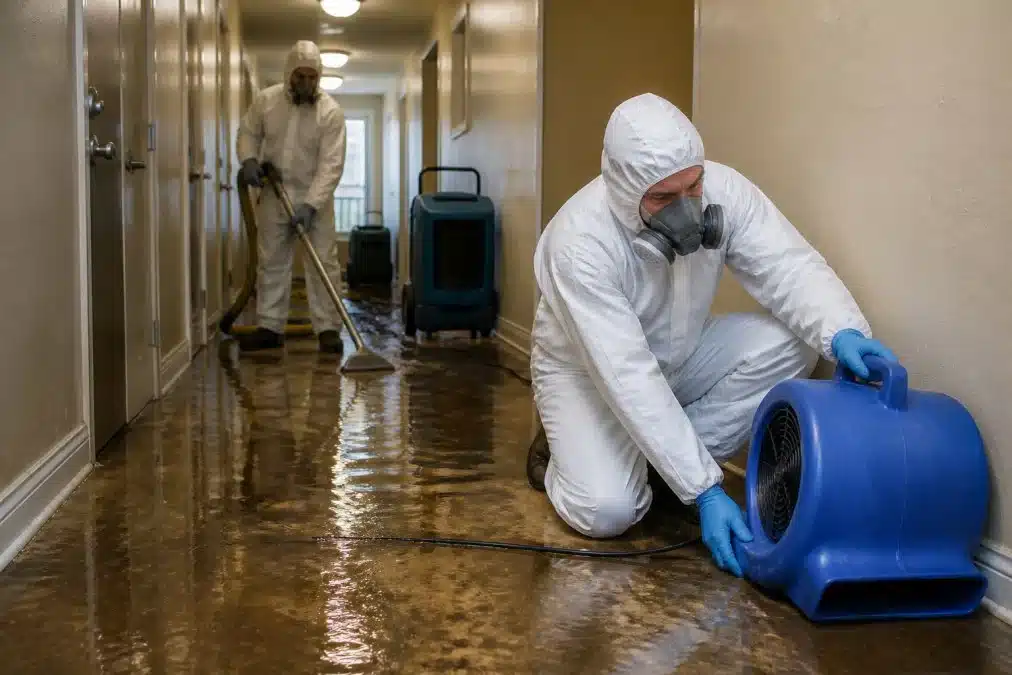
Commercial water damage restoration moves through a fixed sequence, and the order matters more than the speed of any single step. Water extraction comes first, then structural drying and dehumidification, then moisture verification before any rebuild conversation begins. What separates a two-week loss from a two-month loss is how the first 24 hours are run, and property managers, not crews, control most of that window.
The First 24 Hours, Hour by Hour
Hour 0-1: Stop the source and protect the building. Shut off the supply at the unit or riser, or call emergency plumbing support for a failed line. If the loss is above the ground floor, water is already traveling down through penetrations, chase it before it reaches the unit below. Post a staff member at the affected doorway to keep residents out; curiosity traffic is how a contained loss becomes a liability claim.
Hour 1-4: Extract standing water. Extraction is measured in gallons per minute, and the clock is the enemy. Water wicks up drywall roughly one inch per hour in a saturated wall cavity, and it travels laterally along joists and subfloor seams into units that look dry from the hallway (peer-reviewed research). Extraction crews should be pulling water, not surveying.
Hour 4-24: Start drying and set the baseline. Industrial air movers and dehumidification equipment run continuously until moisture readings return to baseline. The baseline is the number that matters: take penetrating moisture readings in every affected room and in the units above, below, and beside the loss before equipment is placed. Those readings become the reference point for every drying decision and every insurance conversation that follows.
What Changes by Loss Type
Not every water loss is handled the same way, and treating them identically is how property managers end up with disputes.
- Clean supply-line water: Standard extraction and drying. The main risk is time, not contamination.
- Sewage backup: Stricter protective measures apply because contaminated water carries health risks that clean supply-line water does not. Affected porous materials are typically removed rather than dried in place, and the affected area is isolated from residents until the work is complete.
- Appliance and HVAC failures: Often slow leaks that have been running for days before anyone notices. Expect hidden saturation in cabinets, closet floors, and the unit below.
- Roof and window intrusion: Usually storm-driven and often affects multiple units at once. Prioritize by which units have active water entry versus which are already saturated.
The Property Manager’s Decision Points
Three decisions in the first day determine how the rest of the loss unfolds:
- Who authorizes emergency mitigation. If the on-site manager needs a board vote to approve extraction, hours disappear. Written spending authority for the first 24 hours is the single highest-leverage item in any recovery plan.
- Whether affected units are vacated. Drying equipment is loud, hot, and runs around the clock. Residents who stay in a unit under active drying often unplug equipment to sleep, which resets the drying clock. Relocation is usually faster than fighting the equipment.
- When documentation starts. Photograph before anything is moved. Moisture readings, room-by-room photos, and equipment placement logs taken in the first day are the evidence that supports the claim later.
Assign one staff member as the documentation lead for the duration of the loss. Rotating the job between shifts is how photo sets end up with gaps, and gaps are where adjusters ask questions.
Drying Is a Measurement Process, Not a Calendar
Drying timelines depend on moisture readings, not on a promised date. A common pattern is three to five days for a contained clean-water loss in a single unit, longer when water has reached wall cavities, subfloor, or multiple units (the EPA). The drying log, daily readings, equipment placement, and equipment run hours, is what tells you when the structure is actually dry. Skipping verification before rebuild is how a dry-looking wall becomes a second loss three months later.
Multifamily Property Disaster Recovery Plan
A multifamily property disaster recovery plan is a written document that assigns every recovery task to a named person before a loss happens. It covers communication, relocation, vendor coordination, and insurance documentation in one place.
Build yours in these sections:
- Roles: who speaks to tenants, who speaks to the insurer, who manages vendors
- Tenant displacement: which units are priority for relocation and what temporary housing options exist
- Vendor roster: restoration, plumbing, electrical, and security contacts
- Documentation: where leases, unit inventories, and prior inspection reports are stored off-site
The gap most plans leave is authority. If the on-site manager cannot approve emergency mitigation without a board vote, hours disappear. Give one person written spending authority for the first 24 hours.
Insurance Claims Process for Commercial Property Damage
The insurance claims process for commercial property damage runs on documentation, not negotiation. Insurers pay what the file supports, which is why the first photos and moisture readings matter more than any later conversation. Most competing guides stop at “call your insurer and keep your receipts.” That advice is not wrong, but it leaves the property manager holding a folder of loose photos and hoping the adjuster connects the dots. The section below is the part competitors skip: how to build a claim file that answers the adjuster’s questions before they are asked.
The Claim File, Organized the Way Adjusters Read It
Adjusters work from a standard set of questions. A file that answers them in order moves faster than one that requires follow-up.
| Claim Element | What to Gather | Why It Matters |
|---|---|---|
| Cause of loss | Photos, incident report, plumber’s note, date and time of discovery | Establishes the covered peril and the start of the loss clock |
| Damage scope | Moisture readings, room-by-room photos, unit-by-unit inventory | Prevents scope disputes and “we didn’t see that” pushback |
| Mitigation record | Vendor invoices, equipment logs, drying readings by day | Supports emergency costs as reasonable and necessary |
| Business impact | Lost rent by unit, displaced-unit count, days uninhabitable | Documents additional loss beyond the physical damage |
| Communication log | Tenant notices sent, vendor calls made, adjuster contact dates | Shows the loss was managed, not ignored |
Documenting Damage the Way an Adjuster Expects
Photos without context are the most common reason a claim stalls. A photo of a wet hallway tells the adjuster nothing about scope. A photo of the same hallway with a moisture meter reading visible in frame, taken on a dated phone, tells them the wall was saturated on a specific day. preventing flat roof damage.
A practical documentation standard:
- Shoot wide, then close. One wide shot per room to establish location, then close shots of every wet surface, every damaged item, and every moisture reading.
- Keep the meter in the frame. Moisture readings are the language of water claims. A reading without a photo is an assertion; a reading with a photo is evidence.
- Log equipment by day. Air movers and dehumidifiers placed on day one and pulled on day four is a different cost than equipment that ran for two weeks. The log is what supports the invoice.
- Note what was not damaged. Adjusters value negative findings, units inspected and found dry, areas checked and cleared. It narrows the scope and speeds approval.
Direct Insurance Billing and What It Changes
Direct insurance billing removes the awkward step of fronting mitigation costs while a claim is pending. For a property manager, the practical effect is that emergency work can begin without waiting on a check, and the restoration vendor communicates with the adjuster directly on scope and documentation. The property manager’s job shifts from middleman to reviewer, confirming the file is complete rather than assembling it from scratch.
Where Claims Actually Go Wrong
A common pattern in disputed multifamily claims is not a coverage fight, it is a documentation gap. Three failure points account for most of them:
- Late discovery. A slow leak behind a vanity that ran for a week looks like a pre-existing condition to an adjuster unless the discovery date is documented. The incident report and the first photos are what establish the timeline.
- Scope creep in the other direction. Under-documenting the loss to “keep it simple” leads to a settlement that does not cover the actual repair. The file should reflect the full scope, not the convenient scope.
- Missing mitigation evidence. Emergency costs are scrutinized more than repair costs. Without equipment logs and daily readings, mitigation invoices look like padding even when they are not.
Do not promise a completion date in the first 48 hours, and do not commit to a settlement figure with a resident or a board. Drying timelines depend on moisture readings, and claim outcomes depend on the file. Confirm what you can confirm, and document the rest.
Working With the Adjuster, Not Against Them
Property managers who walk the adjuster through a complete file, cause, scope, mitigation, impact, communication, tend to see fewer back-and-forth requests than those who hand over a folder of loose photos. The walkthrough is not a negotiation; it is a guided tour of evidence that already exists. The goal is a file so complete that the adjuster’s only remaining question is when the work can start.
Tenant Communication Templates for Disaster Restoration
Tenant communication during a disaster decides whether a manageable loss turns into a complaint file. Clear, early, repeated updates do more for retention than any apology issued later.
Use these templates as starting points.
Initial notice (within two hours):
“We are aware of the water damage affecting [building/units]. Emergency crews are on site. Please avoid the affected area and do not attempt to move belongings. We will send an update by [time].”
Displacement notice:
“Units [numbers] are temporarily uninhabitable. Temporary housing has been arranged at [location]. Please bring medications and essential items. A staff member will meet you in the lobby at [time].”
Daily update:
“Restoration work continues in [area]. Current status: [milestone]. Next update: [time]. Direct questions to [name] at [contact].”
Do not promise a completion date in the first 48 hours. Drying timelines depend on moisture readings, and a missed date you invented creates more frustration than an honest “we will confirm by Thursday.”
Preventative Maintenance Checklists for Apartment Complexes
Preventative maintenance is the cheapest disaster mitigation strategy available to a property manager. Most water losses trace back to a small number of predictable failure points, and each one can be inspected on a schedule.
Run this checklist monthly:
- Supply lines under every sink and behind every toilet
- Water heater anode rods and surrounding pans
- HVAC condensate drain lines and pans
- Exterior grading and downspout drainage
- Sump pumps and backup power where installed
- Shutoff valve operation, tested by hand
Quarterly, add roof drain inspection, window and door seal checks, and a review of the vendor call list. Annual items include a full plumbing pressure check and a walkthrough of the emergency protocol with all staff.
The five-minute supply line check is the highest-return task on this list. A cracked line behind a single vanity can flood three units below it before anyone notices (hud.gov).
Emergency disaster restoration for apartment complexes rewards preparation over reaction. When a loss hits, you need a crew that arrives fast, documents thoroughly, and works directly with your insurer instead of handing you a bill to sort out later. Mr. Restore provides 24/7 emergency response with a 60-minute arrival guarantee, IICRC-certified technicians, direct insurance billing, and real-time project updates through our Job-Dox system so you always know where the work stands. Get started with Mr. Restore and turn a building emergency into a managed recovery.
Frequently Asked Questions
Who is responsible for apartment flooding?
Responsibility depends on the source of the water. If the flood comes from a plumbing failure inside a tenant’s unit, the tenant may be liable. If it originates from common areas or structural issues, the property owner or manager is typically responsible. Review your lease agreements and consult your insurance provider to determine liability. Document everything immediately with photos and notes to support your claim.
How can property managers minimize secondary damage after a flood or fire?
Act within the first 24 to 48 hours. Call a professional restoration company immediately for water extraction and structural drying. Remove standing water, ventilate the area, and document all damage. Secondary damage like warped floors, stained ceilings, and compromised drywall can multiply repair costs. A rapid response also reduces tenant displacement time and helps preserve your insurance claim.
What documentation is required for insurance claims after apartment property damage?
You will need photos and videos of all damage, a written inventory of affected units and common areas, receipts for emergency repairs, and a detailed report from your restoration contractor. Keep copies of all communication with tenants and vendors. Your insurance adjuster may also request proof of maintenance records. A restoration company experienced with commercial claims can help compile this documentation.
What are the benefits of having a pre-established relationship with a restoration company?
A pre-established relationship means faster response times, priority scheduling, and a team already familiar with your property layout. You avoid scrambling to vet contractors during an emergency. Many restoration companies offer disaster planning assistance and can coordinate directly with your insurance provider. This reduces downtime, limits secondary damage, and helps you get tenants back into their units sooner.