

Table of Contents
- What Businesses Should Compare in a Restoration Provider
- Top Belfor Alternatives for Businesses at a Glance
- Mr. Restore: 60-Minute Arrival and Direct Insurance Billing
- 1-800 WATER DAMAGE: National Network With Local Franchise Coverage
- Commercial Water Damage Restoration Services for Large Facilities
- Choosing Emergency Storm Damage Repair Contractors
- Insurance Claims Assistance for Business Owners
- Why IICRC Certified Restoration Providers Matter
- Frequently Asked Questions
Last Updated: September 15, 2026
What Businesses Should Compare in a Restoration Provider
When a pipe bursts or a storm tears through your building, the company you call decides how fast you reopen. This guide from Mr. Restore breaks down the best Belfor alternatives for businesses, and it starts with what actually matters: arrival time, certification, and who handles the insurance paperwork.
Service level agreements separate serious restoration partners from call centers. Before you sign anything, compare these five areas:
- Response time guarantees. A written arrival window, not a verbal promise.
- Certification. IICRC-certified technicians trained in structural drying and contents restoration.
- Insurance handling. Direct billing and claims management, so you are not fronting costs.
- Commercial capacity. Equipment and crews sized for large facilities, not just houses.
- Communication. Real-time project updates instead of silence.
Most providers look identical on a homepage. They are not identical at 2 a.m. on a Sunday.
Top Belfor Alternatives for Businesses at a Glance
The table below summarizes how the leading options compare on the criteria that matter most to commercial property owners.
| Provider | Response Commitment | Insurance Support | Best For |
|---|---|---|---|
| Mr. Restore | 60-minute arrival guarantee | Direct insurance billing | Businesses needing speed and claim help |
| 1-800 WATER DAMAGE | 24/7 emergency dispatch | Works with adjusters | Franchise-covered metro areas |
| Regional independents | Varies by owner | Usually handled by you | Single-site, non-urgent projects |
How We Evaluated These Providers
We scored each provider on arrival guarantees, certification, commercial experience, insurance claims assistance, and communication during a project. Providers that could not document a response commitment ranked lower, regardless of company size. The result favors operators who put their promises in writing.
Mr. Restore: 60-Minute Arrival and Direct Insurance Billing
Mr. Restore is a family-owned, IICRC-certified restoration company built around a 60-minute arrival guarantee and 24/7/365 emergency response. That single commitment changes the math on secondary damage: the faster equipment arrives, the less structural material gets soaked through.
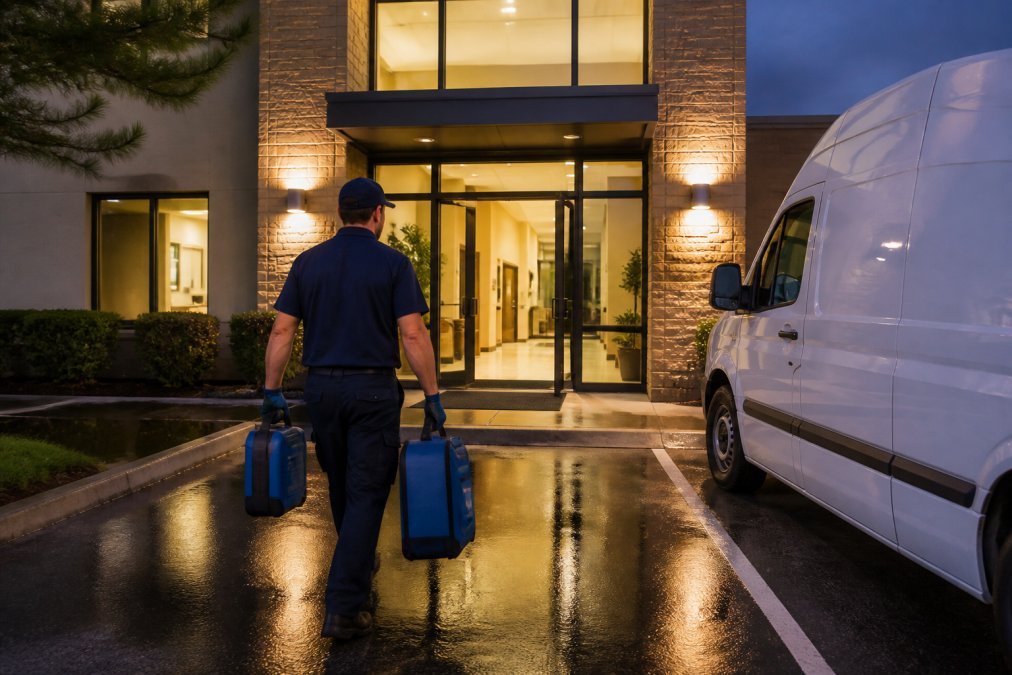
For business owners, the operational difference shows up in three places. Direct insurance billing means your claim starts moving without you writing checks up front. The Job-Dox system gives you real-time project updates, so a restaurant owner can tell staff when to return. And the crews handle both commercial and residential losses, from sewage backups to smoke damage.
Ask any provider to put the arrival window in writing before you sign. A guarantee you cannot point to in a contract is marketing, not a service level agreement.
1-800 WATER DAMAGE: National Network With Local Franchise Coverage
1-800 WATER DAMAGE runs on a franchise model, which gives it broad geographic coverage and standardized protocols across water damage remediation and fire and smoke cleanup. The trade-off is consistency: your experience depends on the local franchise owner, not the national brand. This variability becomes particularly critical when dealing with the specialized requirements of emergency sewage cleanup, where the effectiveness of the response hinges entirely on the specific training and equipment available at the local level.
For a property manager with sites in multiple metros, that network can simplify vendor management. For a single facility, a strong local operator often matches the service at a lower overhead.
Pros:
- National network with standardized service protocols
- Rapid 24/7 emergency dispatch
Cons:
- Availability depends on local franchise coverage
- Service quality varies by owner
Commercial Water Damage Restoration Services for Large Facilities
Commercial losses are not residential losses at a bigger scale. A burst riser in a multifamily building floods several units at once. A distribution center loses throughput by the hour. A clinic has to protect patient records and keep certain areas sealed off while drying runs. The provider you choose is really a business continuity vendor, and the contract should read that way.
What a Commercial SLA Should Actually Contain
Most providers advertise “24/7 emergency response” and stop there. A service level agreement for a commercial account should go further and put the following in writing:
- Notification-to-arrival window. A stated number of minutes or hours from your call, with a defined clock (does it start at first contact or at dispatch confirmation?).
- On-site assessment deadline. When a qualified project manager, not just a technician, will be on site to scope the loss.
- Day-one equipment commitment. The minimum quantity of commercial-grade dehumidifiers and air movers guaranteed to arrive in the first response, scaled to your square footage.
- Daily documentation cadence. Moisture readings, photos, and drying logs delivered on a set schedule, not on request.
- Single point of contact. A named project manager and a backup, with a defined response time for status questions.
- Escalation path. Who you call when the SLA is missed, and what the remedy is.
- Catastrophe clause. What happens to your priority when a regional event overwhelms the provider’s capacity.
If a provider will not commit to those terms in writing, you are comparing marketing, not service levels. A useful exercise is to send the same short SLA questionnaire to three providers and score the answers side by side.
Sector-Specific Protocols to Ask About
Generic “commercial” experience is not the same as experience in your building type. The operational questions change by sector:
- Healthcare and clinics. Can crews work in occupied facilities with infection-control precautions, after-hours scheduling, and containment that keeps patients and staff separated from the work zone?
- Manufacturing and warehousing. Can the provider stage drying around production lines, protect inventory and raw materials, and coordinate with your safety officer on lockout and site access?
- Data centers and telecom rooms. Do they understand that the priority is protecting powered equipment and cabling, and can they work within your change-control process rather than around it?
- Multifamily and hospitality. Can they handle multiple affected units at once, document each unit separately for the claim, and communicate with residents or guests through a single channel?
- Retail and food service. Do they understand perishable inventory, health-department reopening requirements, and the difference between “dry enough to enter” and “cleared to reopen”?
Ask for two references in your sector, not two references in general.
The Metric That Matters: Downtime, Not Drying
Drying is the method. Downtime is the outcome your ownership cares about. When you evaluate providers, ask them to describe how they shorten the closure window:
- Do they phase the work so part of the facility can reopen while drying continues elsewhere?
- Do they bring enough capacity on day one to avoid a second equipment delivery that stalls progress?
- Do they produce the documentation your insurer needs without a back-and-forth that adds days?
- Do they give you a realistic reopening estimate early, so you can plan staffing and customer communication?
A provider that treats your facility as a business continuity problem will talk about reopening phases, not just moisture content.
Score providers on three numbers: guaranteed arrival window, day-one equipment commitment, and documented downtime from a comparable loss. Everything else is a brochure claim.
Choosing Emergency Storm Damage Repair Contractors
Why Pre-Season Selection Beats Post-Storm Shopping
How Catastrophe Response Actually Works
Pre-Season Checklist for Commercial Properties
Red Flags After the Storm
Signing with the first crew that knocks after a storm is the most common and most expensive mistake. A legitimate provider will welcome your questions, document everything, and never rush you into a signature.
Insurance Claims Assistance for Business Owners
The fastest claims are the best-documented ones. Choose a provider that photographs, logs, and reports every stage of the work.
Why IICRC Certified Restoration Providers Matter
Frequently Asked Questions
Is BELFOR a good company for commercial restoration?
BELFOR is one of the largest restoration networks in the country, with broad geographic coverage and experience on large-loss commercial projects. That scale can mean longer dispatch windows for smaller jobs and less flexibility on scheduling. Businesses that need a guaranteed 60-minute arrival, direct insurance billing, and a single point of contact often find regional providers better suited to their needs.
What should businesses look for when choosing a restoration company?
Start with three things: response time guarantees in writing, IICRC certification for the technicians who will actually be on site, and a clear process for working with your insurer. Ask how the company documents the loss, who handles the claim file, and how you will receive progress updates. A service level agreement that names specific response windows and communication cadence separates serious providers from those that only promise speed.
How does IICRC certification impact restoration quality?
IICRC certification means technicians have completed training and testing on recognized standards for water damage, structural drying, and related work. For a business, that translates into drying decisions based on documented moisture readings rather than guesswork, which reduces the chance of repeat damage and disputed insurance claims. Ask for certificate numbers and confirm they are current before work begins.
How quickly can a restoration provider respond to a business emergency?
Response times vary widely. National networks often route calls through a central dispatch center, which can add delay before a local crew is assigned. Providers with a stated arrival guarantee, like a 60-minute window, commit to a specific timeline you can hold them to. Confirm whether the guarantee applies to your property type and location, and get it in writing before you sign anything.
What is the importance of a 24/7 emergency response guarantee for businesses?
Water and smoke damage worsen by the hour. A burst pipe overnight or a fire on a holiday weekend can mean tens of thousands of dollars in secondary damage if mitigation does not start quickly. A 24/7 guarantee means crews are dispatched around the clock, not routed to an answering service. For restaurants, retail, and office buildings, that speed is often the difference between reopening in days and closing for weeks.
When a disaster hits, the difference between reopening in days and losing weeks comes down to who you called and how fast they arrived. Mr. Restore combines a 60-minute arrival guarantee, 24/7/365 emergency response, direct insurance billing, and real-time Job-Dox project updates so you always know where your recovery stands. Get started with Mr. Restore and get your business back to operating.